Walter Frederick "Fritz" Mondale (born January 5, 1928) is an American politician, diplomat and lawyer who served as the 42nd vice president of the Un...
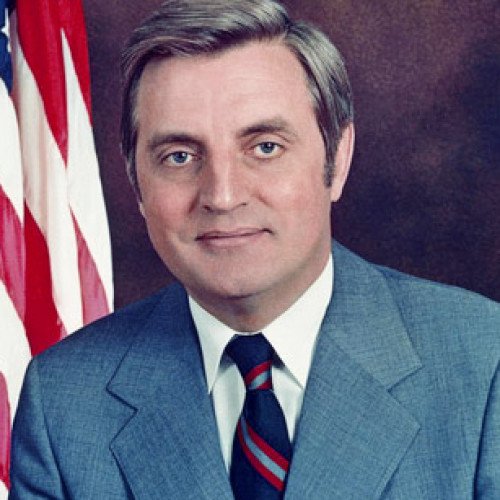
Walter Frederick "Fritz" Mondale (born January 5, 1928) is an American politician, diplomat and lawyer who served as the 42nd vice president of the United States from 1977 to 1981. A United States senator from Minnesota (1964–1976), he was the Democratic Party's nominee in the 1984 United States presidential election, but lost to incumbent Ronald Reagan in an Electoral College and popular vote landslide. Reagan won 49 states while Mondale carried his home state of Minnesota and the District of Columbia. In October 2002, Mondale became the last-minute choice of the Minnesota Democratic–Farmer–Labor Party to run for Senate after the death of Senator Paul Wellstone, but was defeated by Saint Paul Mayor Norm Coleman. Mondale became the oldest living former U.S. vice president after the death of George H. W. Bush in 2018.
Mondale was born in Ceylon, Minnesota, and graduated from the University of Minnesota in 1951 after attending Macalester College. He then served in the United States Army during the Korean War before earning a law degree in 1956. He married Joan Adams in 1955. Working as a lawyer in Minneapolis, Mondale was appointed Minnesota Attorney General in 1960 by Governor Orville Freeman and was elected to a full term as attorney general in 1962 with 60% of the vote. He was appointed to the U.S. Senate by Governor Karl Rolvaag upon the resignation of Senator Hubert Humphrey following Humphrey's election as vice president in 1964. Mondale was elected to a full Senate term in 1966 and reelected in 1972, resigning in 1976 as he prepared to succeed to the vice presidency in 1977. While in the Senate, he supported consumer protection, fair housing, tax reform, and the desegregation of schools. Importantly, he served as a member of the Select Committee to Study Governmental Operations with Respect to Intelligence Activities ("Church Committee").In 1976, Jimmy Carter, the Democratic presidential nominee, chose Mondale as his vice-presidential running mate. The Carter–Mondale ticket defeated incumbent president Gerald Ford and his vice presidential running mate, Bob Dole. Carter and Mondale's time in office was marred by a worsening economy and they lost the 1980 election to Republicans Ronald Reagan and George H. W. Bush. In 1984, Mondale won the Democratic presidential nomination and campaigned for a nuclear freeze, the Equal Rights Amendment, an increase in taxes, and a reduction of U.S. public debt. His vice presidential nominee was Geraldine Ferraro, a Congresswoman from New York, the first female vice-presidential nominee of any major party. Mondale and Ferraro lost the election to the incumbents Reagan and Bush.
After his defeat, Mondale joined the Minnesota-based law firm Dorsey & Whitney and the National Democratic Institute for International Affairs (1986–93). President Bill Clinton appointed Mondale United States Ambassador to Japan in 1993; he retired in 1996. In 2002, Mondale ran for his old Senate seat, agreeing to be the last-minute replacement for Democratic Senator Paul Wellstone, who died in a plane crash less than two weeks before the election. Mondale narrowly lost the race to Saint Paul mayor Norm Coleman. He then returned to working at Dorsey & Whitney and remained active in the Democratic Party. Mondale later took up a part-time teaching position at the University of Minnesota's Hubert H. Humphrey School of Public Affairs.
VS
Steve King
Steven Arnold King (born May 28, 1949) is an American politician and former businessman who served as the U.S. Representative for Iowa's 4th congressi...
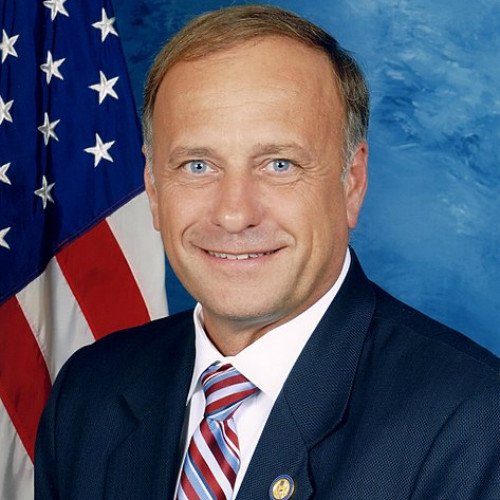
Steven Arnold King (born May 28, 1949) is an American politician and former businessman who served as the U.S. Representative for Iowa's 4th congressional district from 2003 to 2021. A member of the Republican Party, he represented Iowa's 5th congressional district until redistricting.
Born in 1949 in Storm Lake, Iowa, King attended Northwest Missouri State University from 1967 to 1970 but left without graduating. He founded a construction company in 1975 and worked in business and environmental study before seeking the Republican nomination for a seat in the Iowa Senate in 1996. He won the primary and the general election, and was reelected in 2000. In 2002 King was elected to the U.S. House of Representatives from Iowa's 5th congressional district after the incumbent, Tom Latham, was reassigned to the 4th district after redistricting. He was reelected four times before the 2010 United States Census removed the 5th district and placed King in the 4th, which he represented from 2013.
King is an opponent of immigration and multiculturalism, and has a long history of racist and anti-immigrant rhetoric and white-nationalist affiliations. The Washington Post described King as "the Congressman most openly affiliated with white nationalism." King has been criticized for alleged affiliation with white supremacist ideas, and has made controversial statements against immigrants, and supported European right-wing populist and far-right politicians accused of racism and Islamophobia.For much of King's congressional tenure, Republican politicians and officials were silent about his rhetoric, and frequently sought his endorsement and campaigned with him because of his popularity with northwest Iowa's conservative voters. Shortly before the 2018 election, the National Republican Congressional Committee withdrew funding for King's reelection campaign and its chairman, Steve Stivers, condemned King's conduct, although Iowa's Republican senators and governor continued to endorse him. King was reelected, but after a January 2019 interview in which he questioned the negative connotations of the terms "white nationalist" and "white supremacy", he was widely condemned by both parties, the media and public figures, and the Republican Steering Committee removed him from all House committee assignments. King ran for reelection but, campaign funding and support having declined, lost the June 2020 Republican primary to Randy Feenstra.



Comments (0)
No comments yet. Be the first to share your thoughts!