Michael Rubens Bloomberg (born February 14, 1942) is an American businessman, politician, philanthropist, and author. He is the majority owner and co...
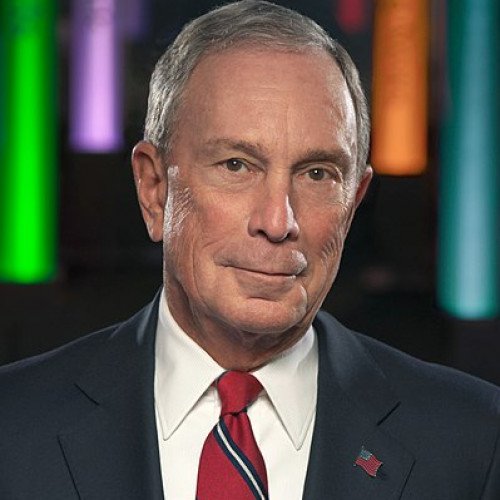
Michael Rubens Bloomberg (born February 14, 1942) is an American businessman, politician, philanthropist, and author. He is the majority owner and co-founder of Bloomberg L.P. He was the mayor of New York City from 2002 to 2013, and was a candidate for the 2020 Democratic nomination for president of the United States.
Bloomberg grew up in Medford, Massachusetts, and graduated from Johns Hopkins University and Harvard Business School. He began his career at the securities brokerage Salomon Brothers before forming his own company in 1981. That company, Bloomberg L.P., is a financial information, software and media firm that is known for its Bloomberg Terminal. Bloomberg spent the next twenty years as its chairman and CEO. In 2020, Forbes ranked him as the sixteenth-richest person in the world, with an estimated net worth of $48 billion as of April 7, 2020 and as of July 21, 2020, Bloomberg ranked 8th in Forbes 400 with net worth $60.1 billion. Since signing The Giving Pledge, Bloomberg has given away $8.2 billion.
Bloomberg was elected the 108th mayor of New York City. First elected in 2001, he held office for three consecutive terms, winning re-election in 2005 and in 2009. Pursuing socially liberal and fiscally moderate policies, Bloomberg developed a technocratic managerial style. After a brief stint as a full-time philanthropist, he re-assumed the position of CEO at Bloomberg L.P. by the end of 2014.
As mayor of New York, Bloomberg established public charter schools, rebuilt urban infrastructure, and supported gun control, public health initiatives, and environmental protections. He also led a rezoning of large areas of the city, which facilitated massive and widespread new commercial and residential construction after the September 11 attacks. Bloomberg is considered to have had far-reaching influence on the politics, business sector, and culture of New York City during his three terms as mayor. He has also faced significant criticism for his expansion of the city's stop and frisk program, support for which he reversed with an apology before his 2020 presidential run.In November 2019, Bloomberg officially launched his campaign for the Democratic nomination for president of the United States in the 2020 election. He ended his campaign in March 2020, after having won only 61 delegates. Bloomberg self-funded $935 million for his candidacy, which set the record for the most expensive U.S. presidential primary campaign.
VS
Donald Rumsfeld
Donald Henry Rumsfeld (born July 9, 1932) is a retired American politician. Rumsfeld served as Secretary of Defense from 1975 to 1977 under Gerald For...
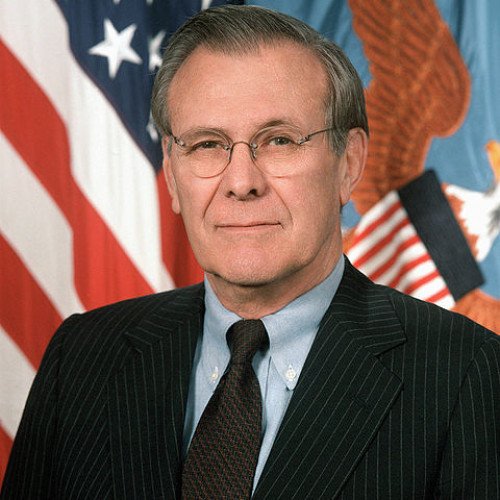
Donald Henry Rumsfeld (born July 9, 1932) is a retired American politician. Rumsfeld served as Secretary of Defense from 1975 to 1977 under Gerald Ford, and again from January 2001 to December 2006 under George W. Bush. He is both the youngest and the second-oldest person to have served as Secretary of Defense. Additionally, Rumsfeld was a three-term U.S. Congressman from Illinois (1963–69), director of the Office of Economic Opportunity (1969–70), counsellor to the president (1969–73), the United States Permanent Representative to NATO (1973–74), and White House Chief of Staff (1974–75). Between his terms as Secretary of Defense, he served as the CEO and chairman of several companies.
Born in Illinois, Rumsfeld attended Princeton University, graduating in 1954 with a degree in political science. After serving in the Navy for three years, he mounted a campaign for Congress in Illinois's 13th Congressional District, winning in 1962 at the age of 30. While in Congress, he was a leading co-sponsor of the Freedom of Information Act. Rumsfeld reluctantly accepted an appointment by President Richard Nixon to head the Office of Economic Opportunity in 1969; appointed counsellor by Nixon and entitled to Cabinet-level status, he would also head up the Economic Stabilization Program before being appointed ambassador to NATO. Called back to Washington in August 1974, Rumsfeld was appointed chief of staff by President Ford. Rumsfeld recruited a young one-time staffer of his, Dick Cheney, to succeed him when Ford nominated him to be Secretary of Defense in 1975. When Ford lost the 1976 election, Rumsfeld returned to private business and financial life, and was named president and CEO of the pharmaceutical corporation G. D. Searle & Company. He was later named CEO of General Instrument from 1990 to 1993 and chairman of Gilead Sciences from 1997 to 2001.
Rumsfeld was appointed Secretary of Defense for a second time in January 2001 by President George W. Bush. As Secretary of Defense, Rumsfeld played a central role in the invasion of Afghanistan and invasion of Iraq. Before and during the Iraq War, he claimed that Iraq had an active weapons of mass destruction program; yet no stockpiles were ever found. A Pentagon Inspector General report found that Rumsfeld's top policy aide "developed, produced, and then disseminated alternative intelligence assessments on the Iraq and al Qaida relationship, which included some conclusions that were inconsistent with the consensus of the Intelligence Community, to senior decision-makers". Rumsfeld's tenure was controversial for its use of torture and the Abu Ghraib torture and prisoner abuse scandal. Rumsfeld gradually lost political support and he resigned in late 2006. In his retirement years, he published an autobiography Known and Unknown: A Memoir as well as Rumsfeld's Rules: Leadership Lessons in Business, Politics, War, and Life.



Comments (0)
No comments yet. Be the first to share your thoughts!