Tulsi Gabbard (; born April 12, 1981) is an American politician and United States Army Reserve officer who served as the U.S. Representative for Hawai...
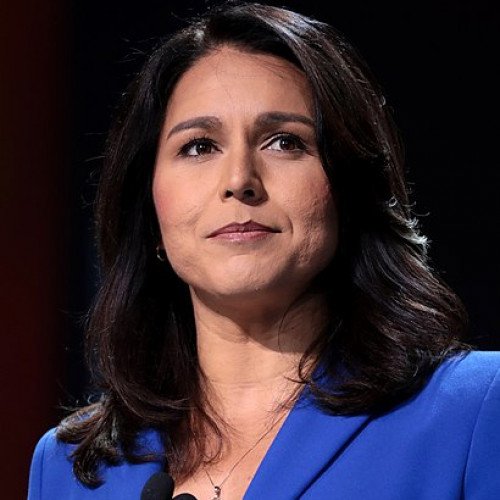
Tulsi Gabbard (; born April 12, 1981) is an American politician and United States Army Reserve officer who served as the U.S. Representative for Hawaii's 2nd congressional district from 2013 to 2021. Elected in 2012, she was the first Hindu member of Congress and also the first Samoan-American voting member of Congress. In early February 2019 she announced her candidacy for the Democratic nomination in the 2020 United States presidential election.In 2002, Gabbard was elected to the Hawaii House of Representatives at the age of 21. Gabbard served in a field medical unit of the Hawaii Army National Guard in Iraq from 2004 to 2005 and was deployed to Kuwait from 2008 to 2009 as an Army Military Police platoon leader. She was a vice chair of the Democratic National Committee from 2013 to 2016, when she resigned to endorse Senator Bernie Sanders for the 2016 Democratic presidential nomination.
Gabbard supports a two-tier universal health care plan that she calls "Single Payer Plus" and strengthening Roe v. Wade by codifying it into federal law. Her position has evolved on the issue and she now believes that abortion should be "safe, legal and rare", although it is not a choice she would personally make. She co-sponsored the Family Act for paid family and medical leave and endorsed universal basic income. She opposes military interventionism, although she has called herself a "hawk" on terrorism. Her decision to meet Syrian President Bashar al-Assad and her skeptical approach to two claims that he had used chemical weapons were controversial.On March 19, 2020, Gabbard dropped out of the 2020 presidential race and endorsed Joe Biden. She had already withdrawn from her U.S. House re-election race during her presidential campaign and was succeeded by Kai Kahele on January 3, 2021.
VS
Robert Reich
Robert Bernard Reich (; born June 24, 1946) is an American economic advisor, professor, author, and political commentator. He served in the administra...
Robert Bernard Reich (; born June 24, 1946) is an American economic advisor, professor, author, and political commentator. He served in the administrations of Presidents Gerald Ford and Jimmy Carter, as well as serving as the United States Secretary of Labor from 1993 to 1997 under Bill Clinton. He was a member of President Barack Obama's economic transition advisory board.Reich has been the Chancellor's Professor of Public Policy at the Goldman School of Public Policy at UC Berkeley since January 2006. He was formerly a professor at Harvard University's John F. Kennedy School of Government and professor of social and economic policy at the Heller School for Social Policy and Management of Brandeis University. He has also been a contributing editor of The New Republic, The American Prospect (also chairman and founding editor), Harvard Business Review, The Atlantic, The New York Times, and The Wall Street Journal.
Reich is a political commentator on programs including Erin Burnett OutFront, CNN Tonight, Anderson Cooper's AC360, Hardball with Chris Matthews, This Week with George Stephanopoulos, CNBC's Kudlow & Company, and APM's Marketplace. In 2008, Time magazine named him one of the Ten Best Cabinet Members of the century, and in the same year The Wall Street Journal placed him sixth on its list of Most Influential Business Thinkers.He has published 18 books which have been translated into 22 languages, including the best-sellers The Work of Nations, Reason, Saving Capitalism, Supercapitalism, Aftershock: The Next Economy and America's Future, and a best-selling e-book, Beyond Outrage. He is also chairman of Common Cause and writes his own blog about the political economy at Robertreich.org. The Robert Reich–Jacob Kornbluth film Saving Capitalism was selected to be a Netflix Original, and debuted in November 2017, and their film Inequality for All won a U.S. Documentary Special Jury Award for Achievement in Filmmaking at the 2013 Sundance Film Festival in Utah.In 2015 Reich and Kornbluth founded Inequality Media, a nonprofit digital media company. Inequality Media's videos feature Reich discussing topics relating to inequality and power primarily in the United States, including universal basic income, the racial wealth gap, affordable housing, and gerrymandering.




Comments (0)
No comments yet. Be the first to share your thoughts!