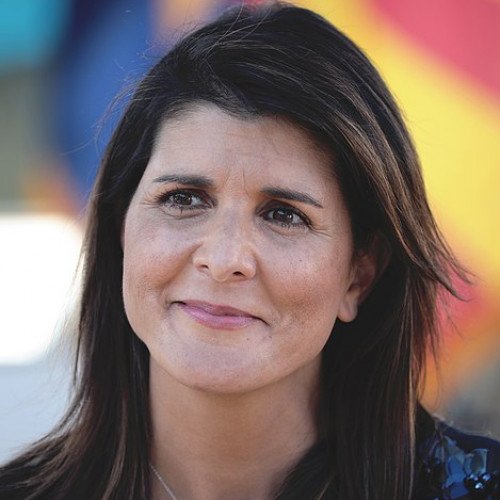
Nimrata Nikki Haley (née Randhawa; born January 20, 1972) is an American politician, diplomat, clothing executive and author who served as the 116th...
Nimrata Nikki Haley (née Randhawa; born January 20, 1972) is an American politician, diplomat, clothing executive and author who served as the 116th governor of South Carolina from 2011 to 2017 and as the 29th United States ambassador to the United Nations from 2017 to 2018.
Haley was the first female governor of South Carolina, the youngest governor in the country and the second governor of Indian descent (after Bobby Jindal of Louisiana). She was the first Asian-American female governor, and in 2017 became the first Indian-American in a presidential cabinet.Haley was born in Bamberg, South Carolina, and studied accountancy at Clemson University. First elected to the South Carolina House of Representatives in 2004, she served three terms. In 2010, during her third term, she was elected governor of South Carolina and won re-election in 2014.
On November 23, 2016, then President-elect Donald Trump announced his intention to nominate then-South Carolina Governor Haley as United States ambassador to the United Nations. She was confirmed by the U.S. Senate in a 96-to-4 vote, and was sworn in on January 25, 2017. She affirmed the United States' willingness to use military force in response to further North Korean missile tests in the wake of the 2017 North Korea crisis, and supported Israel thirteen times. She voluntarily stepped down on December 31, 2018.
VS
Deval Patrick
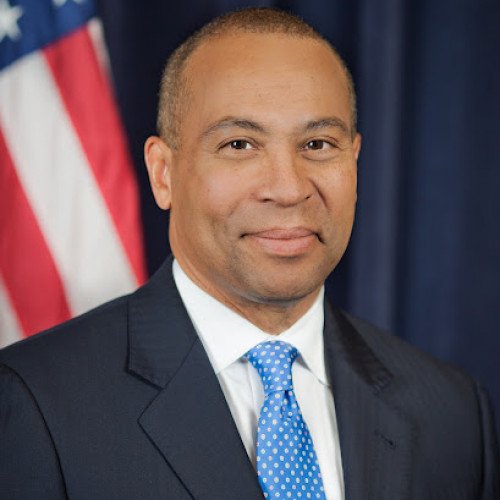
Deval Laurdine Patrick (born July 31, 1956) is an American politician, civil rights lawyer, author, and businessman who served as the 71st governor of...
Deval Laurdine Patrick (born July 31, 1956) is an American politician, civil rights lawyer, author, and businessman who served as the 71st governor of Massachusetts from 2007 to 2015. He was first elected in 2006, succeeding Mitt Romney, who chose not to run for reelection to focus on his presidential campaign. He was reelected in 2010. He was the first African American Governor of Massachusetts. A Democrat, Patrick served from 1994 to 1997 as the United States Assistant Attorney General for the Civil Rights Division under President Bill Clinton. He was briefly a candidate for President of the United States in the 2020 U.S. presidential election.
Raised largely by a single mother on the South Side of Chicago, Patrick earned a scholarship to Milton Academy in Milton, Massachusetts in the eighth grade. He went on to attend Harvard College and Harvard Law School, where he was president of the Harvard Legal Aid Bureau. After graduating, he practiced law with the NAACP Legal Defense and Educational Fund and later joined a Boston law firm, where he was named a partner at age 34. In 1994, Bill Clinton appointed him as the United States assistant attorney general for the civil rights division of the United States Department of Justice, where he worked on issues including racial profiling and police misconduct.
During his governorship, Patrick oversaw the implementation of the state's 2006 health care reform program which had been enacted under Mitt Romney, increased funding to education and life sciences, won a federal Race to the Top education grant, passed an overhaul of governance of the state transportation function, signing a law to create the Massachusetts Department of Transportation, increased the state sales tax from 5% to 6.25%, raised the state's minimum wage from $8 per hour to $11 by 2017, and planned the introduction of casinos to the state. Under Patrick, Massachusetts joined the Regional Greenhouse Gas Initiative (RGGI) in an effort to reduce greenhouse gas emissions. Shortly after Patrick's second term began on January 6, 2011, he declared he would not seek re-election in 2014.Patrick is a managing director at Bain Capital and serves as the chairman of the board for Our Generation Speaks, a fellowship program and startup incubator whose mission is to bring together young Israeli and Palestinian leaders through entrepreneurship. He also holds a Board of Directors position at telehealth company American Well.Members of his own inner circle and Barack Obama's inner circle encouraged Patrick to run for president in 2020, but Patrick ruled out a 2020 presidential bid in December 2018. In November 2019, however, uneasy about the existing field of Democratic candidates, Patrick was reported to have called a few leading Democrats and allies to say that he would soon announce a 2020 presidential bid. He formally entered the race on November 14, 2019. He ended his campaign on February 12, 2020, following a very poor showing in the Iowa caucus and the New Hampshire primary.



Comments (0)
No comments yet. Be the first to share your thoughts!