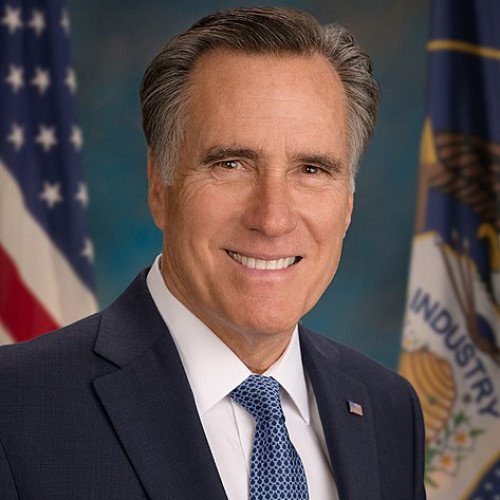
Willard Mitt Romney (born March 12, 1947) is an American politician, businessman and former presidential candidate who has served as the junior United...
Willard Mitt Romney (born March 12, 1947) is an American politician, businessman and former presidential candidate who has served as the junior United States senator from Utah since January 2019. He previously served as the 70th governor of Massachusetts from 2003 to 2007 and was the Republican Party's nominee for president of the United States in the 2012 election.
Raised in Bloomfield Hills, Michigan, by his parents, George and Lenore Romney, he spent over two years from 1966 in France as a Mormon missionary. He married Ann Davies in 1969; they have five sons. By 1971, he had participated in the political campaigns of both parents. In 1971 Romney graduated as a Bachelor of Arts in English from Brigham Young University (BYU) and in 1975 gained the JD–MBA degree from Harvard. Romney became a management consultant and in 1977 joined Bain & Company in Boston. As Bain's chief executive officer (CEO), he later helped lead the company out of a financial crisis. In 1984, he co-founded and led the spin-off company Bain Capital, a private equity investment firm that became one of the largest of its kind in the nation. Active in The Church of Jesus Christ of Latter-day Saints (LDS Church) throughout his adult life, Romney served as bishop of his ward and later as a stake president, for an area covering Boston and many of its suburbs.
After stepping down from Bain Capital and his local leadership role in the LDS Church, Romney ran as the Republican candidate in the 1994 United States Senate election in Massachusetts. After losing to longtime incumbent Ted Kennedy, he resumed his position at Bain Capital. Years later, a successful stint as president and CEO of the then-struggling Salt Lake Organizing Committee for the 2002 Winter Olympics led to a re-launch of his political career. Elected Governor of Massachusetts in 2002, Romney helped develop and later signed a health care reform law (commonly referred to as "Romneycare") that provided near-universal health insurance access through state-level subsidies and individual mandates to purchase insurance. He also presided over the elimination of a projected $1.2–1.5 billion deficit through a combination of spending cuts, increased fees and closing corporate tax loopholes. He did not seek re-election in 2006, instead focusing on his campaign for the Republican nomination in the 2008 U.S. presidential election. Though he won several primaries and caucuses, Romney ultimately lost the nomination to Senator John McCain. Romney's considerable net worth, estimated in 2012 at $190–250 million, helped finance his political campaigns prior to 2012. Romney again ran for and won the Republican presidential nomination in 2012, becoming the first Mormon to be a presidential nominee of a major party. He was defeated by incumbent Democratic President Barack Obama in the 2012 presidential election, losing the Electoral College by a margin of 206–332 and the popular vote by a margin of 47–51%.
After re-establishing residency in Utah, Romney announced his campaign for the U.S. Senate seat held by the retiring Orrin Hatch in the 2018 election; he defeated state representative Mike Kennedy in the Republican primary and Democrat Jenny Wilson in the general election. In doing so, he became only the third individual ever to be elected governor of one state and U.S. senator for another state (the others being Sam Houston and William Bibb). Romney was sworn in on January 3, 2019. In the impeachment trial of Donald Trump, he voted to convict the president of abuse of power (over Trump's attempts to get Ukrainian President Volodymyr Zelensky to announce an investigation into his political rival Joe Biden), becoming the first and only senator in U.S. history to vote to convict a president of his own party.
VS
Howard Dean
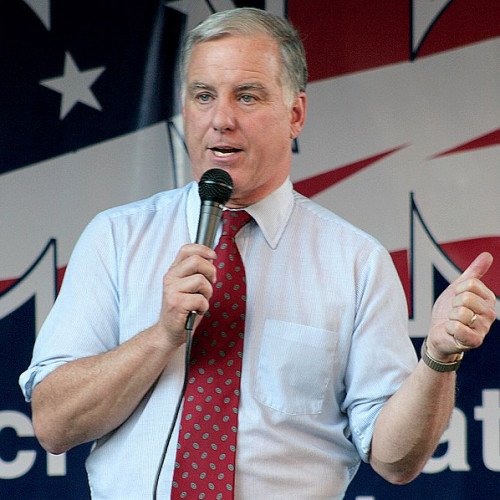
Howard Brush Dean III (born November 17, 1948) is an American physician, author, and retired politician who served as Governor of Vermont from 1991 to...
Howard Brush Dean III (born November 17, 1948) is an American physician, author, and retired politician who served as Governor of Vermont from 1991 to 2003 and Chair of the Democratic National Committee (DNC) from 2005 to 2009. Dean was a candidate for the Democratic nomination in the 2004 presidential election. His implementation of the fifty-state strategy as head of the DNC is credited with the Democratic victories in the 2006 and 2008 elections. Afterward, he became a political commentator and consultant to McKenna Long & Aldridge, a law and lobbying firm.
Before entering politics, Dean earned his medical degree from the Albert Einstein College of Medicine in 1978. Dean served as a member of the Vermont House of Representatives from 1983 to 1986 and as Lieutenant Governor of Vermont from 1987 to 1991. Both were part-time positions that enabled him to continue practicing medicine. In 1991, Dean became governor of Vermont when Richard A. Snelling died in office. Dean was subsequently elected to five two-year terms, serving from 1991 to 2003, making him the second longest-serving governor in Vermont history, after Thomas Chittenden (1778–1789 and 1790–1797). Dean served as chairman of the National Governors Association from 1994 to 1995; during his term, Vermont paid off much of its public debt and had a balanced budget 11 times, lowering income taxes twice. Dean also oversaw the expansion of the "Dr. Dynasaur" program, which ensures universal health care for children and pregnant women in the state. He is a noted staunch supporter of universal health care.Dean denounced the 2003 invasion of Iraq and called on Democrats to oppose the Bush administration. In the 2004 election, Dean was the top fundraiser and front runner, prior to the Iowa caucus, for the Democratic Party presidential nomination. Although he lost the nomination to Senator John Kerry of Massachusetts, Dean pioneered Internet-based fundraising and grassroots organizing, which is centered on mass appeal to small donors which is more cost efficient than the more expensive contacting of fewer potential larger donors, and promotes active participatory democracy among the general public. In 2004, Dean founded Democracy for America, a progressive political action committee. He was later elected chairman of the Democratic National Committee in February 2005. As chairman of the party, Dean created and employed the 50 State Strategy that attempted to make Democrats competitive in normally conservative states often dismissed in the past as "solid red". The success of the strategy became apparent after the 2006 midterm elections, where Democrats took back the House and picked up seats in the Senate from normally Republican states such as Missouri and Montana. In the 2008 presidential election, Barack Obama used the 50 state strategy as the backbone of his candidacy.
Dean was named chairman emeritus of the DNC upon his retirement. Since retiring from the DNC chairman position, Dean has held neither elected office nor an official position in the Democratic Party and, as of 2015, was working for global law firm Dentons as part of the firm's public policy and regulation practice. In 2013, Dean expressed interest in running for the presidency in 2016, but instead supported former Secretary of State Hillary Clinton's run for president. Dean endorsed Clinton over her competitor Senator Bernie Sanders in spite of the fact that Sanders represented the state of Vermont, where Dean had been governor.



Comments (0)
No comments yet. Be the first to share your thoughts!