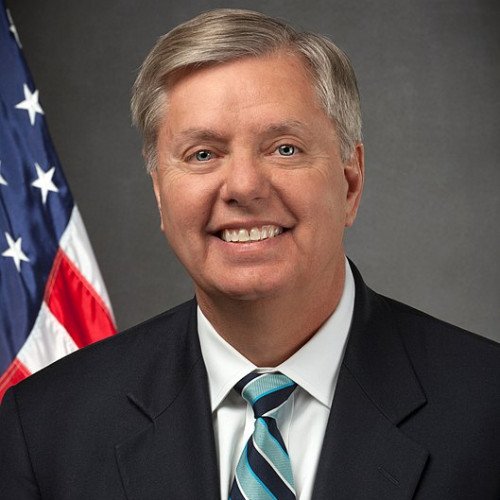
Lindsey Olin Graham (born July 9, 1955) is an American politician serving as the senior United States Senator from South Carolina, a seat he has held...
Lindsey Olin Graham (born July 9, 1955) is an American politician serving as the senior United States Senator from South Carolina, a seat he has held since 2003. A member of the Republican Party, Graham served as chairman of the Senate Committee on the Judiciary from 2019 to 2021.
A native of Central, South Carolina, Graham received his Juris Doctor degree from the University of South Carolina School of Law in 1981. Most of his active duty within his span of military service happened from 1982 to 1988 when he served with the Judge Advocate General's Corps in the United States Air Force, as a defense attorney and then with the Air Force's chief prosecutor in Europe based in West Germany. Later his entire service in the U.S. Air Force Reserve ran concurrently with his congressional career. He was awarded a Bronze Star Medal for meritorious service in 2014.
Graham worked as a lawyer in private practice before serving one term in the South Carolina House of Representatives from 1993 to 1995. He served for four terms in the United States House of Representatives for South Carolina's 3rd congressional district from 1995 to 2003. In 2002, Graham won the U.S. Senate seat vacated by retiring Republican incumbent Strom Thurmond. He won re-election for a fourth term in 2020. Graham is known in the Senate for his advocacy of a strong national defense and aggressive interventionist foreign policy. Initially, he was also known for his willingness to be bipartisan and work with Democrats on issues like campaign finance reform, a ban on waterboarding, immigration reform, and judicial nominees. He has criticized the Tea Party movement, arguing for a more inclusive Republican Party.Graham sought the Republican nomination for president between June and December 2015, dropping out before the 2016 Republican primaries began. He was an outspoken critic of fellow Republican Donald Trump's 2016 candidacy and repeatedly declared he did not support Trump; in particular, he took issue with Trump's comments on Graham's close friend, Senator John McCain. After a March 2017 meeting with Trump, Graham became a staunch ally of the president, often issuing public statements in his defense. His reversal caught both parties by surprise and sparked much media attention. Graham became chairman of the Senate Judiciary Committee in 2019. Graham led the U.S. Supreme Court confirmation hearings for Amy Coney Barrett, who was successfully appointed Associate Justice in October 2020.
VS
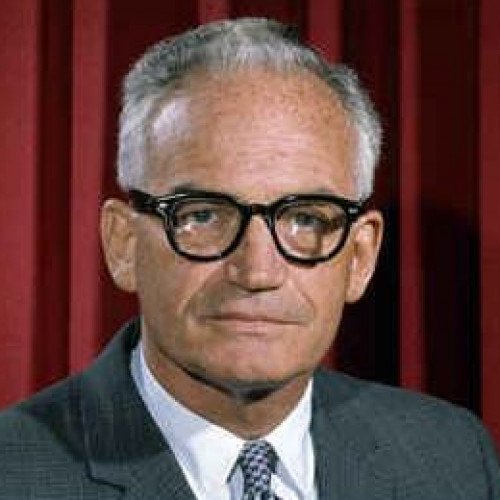
Barry Goldwater
Barry Morris Goldwater (January 2, 1909 – May 29, 1998) was an American politician, businessman, and author who was a five-term Senator from Arizona (...
Barry Morris Goldwater (January 2, 1909 – May 29, 1998) was an American politician, businessman, and author who was a five-term Senator from Arizona (1953–1965, 1969–1987) and the Republican Party nominee for president of the United States in 1964. Despite his loss of the 1964 presidential election in a landslide, Goldwater is the politician most often credited with having sparked the resurgence of the American conservative political movement in the 1960s. He also had a substantial impact on the libertarian movement.Goldwater rejected the legacy of the New Deal and, along with the conservative coalition, fought against the New Deal coalition. A member of the NAACP and active supporter of desegregation in Phoenix, Goldwater voted in favor of the Civil Rights Act of 1957 and the 24th Amendment to the U.S. Constitution, but opposed the Civil Rights Act of 1964, believing it to be an overreach by the federal government—a decision that considerably anguished him. In 1964, Goldwater mobilized a large conservative constituency to win the hard-fought Republican presidential primaries. Although raised as an Episcopalian, Goldwater was the first candidate of ethnically Jewish heritage to be nominated for President by a major American party (his father was Jewish). Goldwater's platform ultimately failed to gain the support of the electorate and he lost the 1964 presidential election to incumbent Democrat Lyndon B. Johnson by one of the largest margins in history. Goldwater returned to the Senate in 1969 and specialized in defense and foreign policy. As an elder statesman of the party, Goldwater successfully urged President Richard Nixon to resign in 1974 when evidence of a cover-up in the Watergate scandal became overwhelming and impeachment was imminent.
Goldwater narrowly won re-election in 1980 for what would be his final and most influential term in the senate. In 1986, Goldwater oversaw passage of the Goldwater–Nichols Act, arguably his most significant legislative achievement, which strengthened civilian authority in the Department of Defense. The following year, he retired from the Senate and was succeeded by John McCain, who praised his predecessor as the man who "transformed the Republican Party from an Eastern elitist organization to the breeding ground for the election of Ronald Reagan". Goldwater strongly supported the 1980 presidential campaign of Reagan, who had become the standard-bearer of the conservative movement after his "A Time for Choosing" speech. Reagan reflected many of the principles of Goldwater's earlier run in his campaign. The Washington Post columnist George Will took note of this, writing: "We [...] who voted for him in 1964 believe he won, it just took 16 years to count the votes".
Goldwater's views grew increasingly libertarian as he neared the end of his career. After leaving the Senate, Goldwater's views cemented as libertarian. He criticized the "moneymaking ventures by fellows like Pat Robertson and others [in the Republican Party] who are trying to... make a religious organization out of it." He lobbied for homosexuals to be able to serve openly in the military, opposed the Clinton administration's plan for health care reform, supported abortion rights, and the legalization of medicinal marijuana.



Comments (0)
No comments yet. Be the first to share your thoughts!