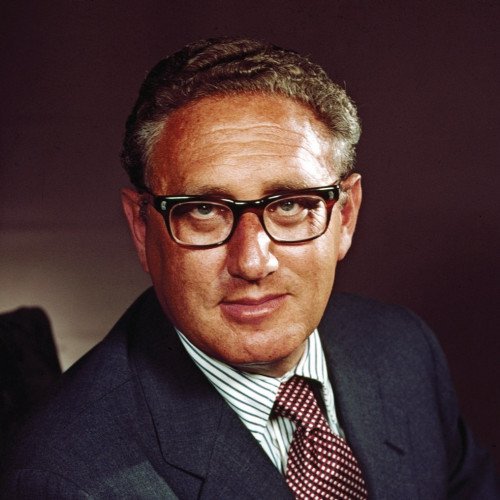
Henry Alfred Kissinger (; German: [ˈkɪsɪŋɐ]; born Heinz Alfred Kissinger; May 27, 1923) is an American politician, diplomat, and geopolitical consult...
Henry Alfred Kissinger (; German: [ˈkɪsɪŋɐ]; born Heinz Alfred Kissinger; May 27, 1923) is an American politician, diplomat, and geopolitical consultant who served as United States Secretary of State and National Security Advisor under the presidential administrations of Richard Nixon and Gerald Ford. A Jewish refugee who fled Nazi Germany with his family in 1938, he became National Security Advisor in 1969 and U.S. Secretary of State in 1973. For his actions negotiating a ceasefire in Vietnam, Kissinger received the 1973 Nobel Peace Prize under controversial circumstances, with two members of the committee resigning in protest.A practitioner of Realpolitik, Kissinger played a prominent role in United States foreign policy between 1969 and 1977. During this period, he pioneered the policy of détente with the Soviet Union, orchestrated the opening of relations with China, engaged in what became known as shuttle diplomacy in the Middle East to end the Yom Kippur War, and negotiated the Paris Peace Accords, ending American involvement in the Vietnam War. Kissinger has also been associated with such controversial policies as U.S. involvement in the 1973 Chilean military coup, a "green light" to Argentina's military junta for their Dirty War, and U.S. support for Pakistan during the Bangladesh War despite the genocide being perpetrated by his allies. After leaving government, he formed Kissinger Associates, an international geopolitical consulting firm. Kissinger has written over a dozen books on diplomatic history and international relations.
Kissinger remains a controversial and polarizing figure in U.S. politics, both condemned as an alleged war criminal by many journalists, political activists, and human rights lawyers, and venerated as a highly effective U.S. Secretary of State by many prominent international relations scholars.
VS
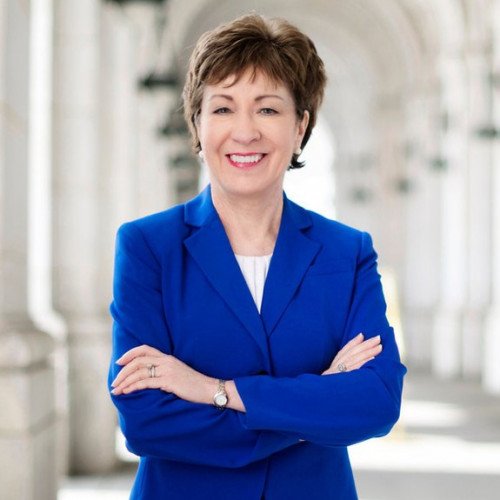
Susan Collins
Susan Margaret Collins (born December 7, 1952) is an American politician serving as the senior United States Senator from Maine. A Republican, she has...
Susan Margaret Collins (born December 7, 1952) is an American politician serving as the senior United States Senator from Maine. A Republican, she has represented Maine in the Senate since 1997.
Born in Caribou, Maine, Collins is a graduate of St. Lawrence University in Canton, New York. Beginning her career as a staff assistant for Senator William Cohen in 1975, she became staff director of the Oversight of Government Management Subcommittee of the Committee on Governmental Affairs (which later became the Committee on Homeland Security and Governmental Affairs) in 1981. Governor John R. McKernan Jr. then appointed her Commissioner of the Maine Department of Professional and Financial Regulation in 1987. In 1992 President George H. W. Bush appointed her director of the Small Business Administration's regional office in Boston. Collins became a deputy state treasurer in the office of the Treasurer and Receiver-General of Massachusetts in 1993. After moving back to Maine in 1994, she became the Republican nominee for governor of Maine in the 1994 general election. She was the first female major-party nominee for the post, finishing third in a four-way race with 23% of the vote. After her bid for governor in 1994, she became the founding director of the Center for Family Business at Husson University in Bangor, Maine.
Collins was first elected to the U.S. Senate in 1996. She was reelected in 2002, 2008, 2014, and 2020. The ranking member of the Senate Special Committee on Aging, she is a former chair of the Senate Committee on Homeland Security and Governmental Affairs. Collins is the most senior Republican woman in the Senate, the dean of Maine's congressional delegation, and the only New England Republican in the 116th and 117th Congresses. She has been called a moderate Republican and is often a pivotal vote in the Senate. To date, Collins is the longest-serving Republican woman in the Senate.



Comments (0)
No comments yet. Be the first to share your thoughts!