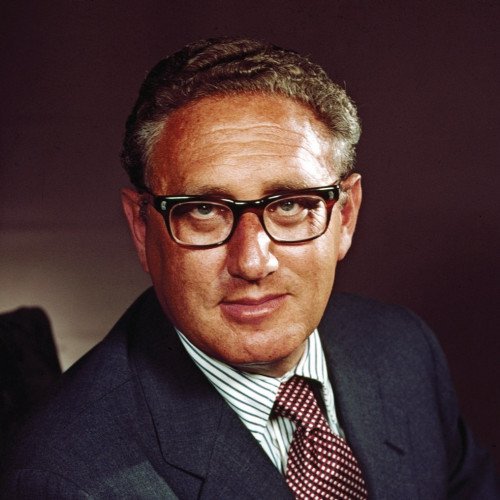
Henry Alfred Kissinger (; German: [ˈkɪsɪŋɐ]; born Heinz Alfred Kissinger; May 27, 1923) is an American politician, diplomat, and geopolitical consult...
Henry Alfred Kissinger (; German: [ˈkɪsɪŋɐ]; born Heinz Alfred Kissinger; May 27, 1923) is an American politician, diplomat, and geopolitical consultant who served as United States Secretary of State and National Security Advisor under the presidential administrations of Richard Nixon and Gerald Ford. A Jewish refugee who fled Nazi Germany with his family in 1938, he became National Security Advisor in 1969 and U.S. Secretary of State in 1973. For his actions negotiating a ceasefire in Vietnam, Kissinger received the 1973 Nobel Peace Prize under controversial circumstances, with two members of the committee resigning in protest.A practitioner of Realpolitik, Kissinger played a prominent role in United States foreign policy between 1969 and 1977. During this period, he pioneered the policy of détente with the Soviet Union, orchestrated the opening of relations with China, engaged in what became known as shuttle diplomacy in the Middle East to end the Yom Kippur War, and negotiated the Paris Peace Accords, ending American involvement in the Vietnam War. Kissinger has also been associated with such controversial policies as U.S. involvement in the 1973 Chilean military coup, a "green light" to Argentina's military junta for their Dirty War, and U.S. support for Pakistan during the Bangladesh War despite the genocide being perpetrated by his allies. After leaving government, he formed Kissinger Associates, an international geopolitical consulting firm. Kissinger has written over a dozen books on diplomatic history and international relations.
Kissinger remains a controversial and polarizing figure in U.S. politics, both condemned as an alleged war criminal by many journalists, political activists, and human rights lawyers, and venerated as a highly effective U.S. Secretary of State by many prominent international relations scholars.
VS
Paul Ryan
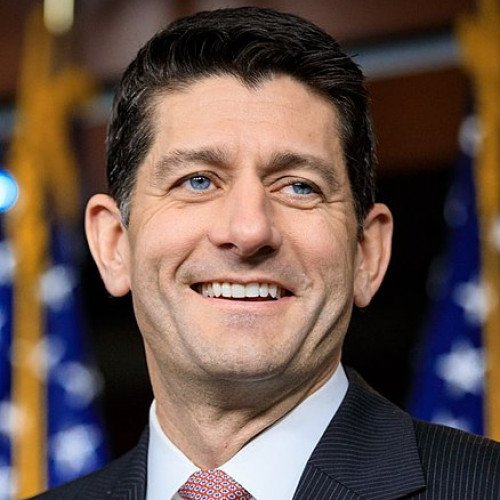
Paul Davis Ryan (born January 29, 1970) is a retired American politician who served as the 54th speaker of the United States House of Representatives...
Paul Davis Ryan (born January 29, 1970) is a retired American politician who served as the 54th speaker of the United States House of Representatives from October 2015 to January 2019. He was also the 2012 vice presidential nominee of the Republican Party, running unsuccessfully alongside Mitt Romney.
Ryan, a native of Janesville, Wisconsin, graduated from Miami University in 1992. He spent five years working for Republicans in Washington, D.C. and returned to Wisconsin in 1997 to work at his family's construction company. Ryan was elected to Congress to represent Wisconsin's 1st congressional district the following year, replacing an incumbent Republican who ran for U.S. Senate. Ryan would represent the district for 20 years. He chaired the House Budget Committee from 2011 to 2015 and briefly chaired the House Ways and Means Committee in 2015 prior to being elected Speaker of the House in October 2015 following John Boehner's retirement.
A self-proclaimed deficit hawk, Ryan was a major proponent of Social Security privatization in the mid-2000s. In the 2010s, two proposals heavily influenced by Ryan—"The Path to Prosperity" and "A Better Way"—advocated for the privatization of Medicare, the conversion of Medicaid into a block grant program, the repeal of the Affordable Care Act, and significant federal tax cuts. As Speaker, he had a role in passage of the Tax Cuts and Jobs Act of 2017. His other major piece of legislation, the American Health Care Act of 2017, passed the House but failed in the Senate by one vote. Despite his past fiscal conservative rhetoric, Ryan's tenure as Speaker of the House—most of which coincided with a period of unified Republican control of the federal government—saw a significant increase in federal government spending and deficits.
Ryan declined to run for re-election in the 2018 midterm elections. With the Democratic Party taking control of the House of Representatives, Nancy Pelosi succeeded Ryan as Speaker of the House.



Comments (0)
No comments yet. Be the first to share your thoughts!