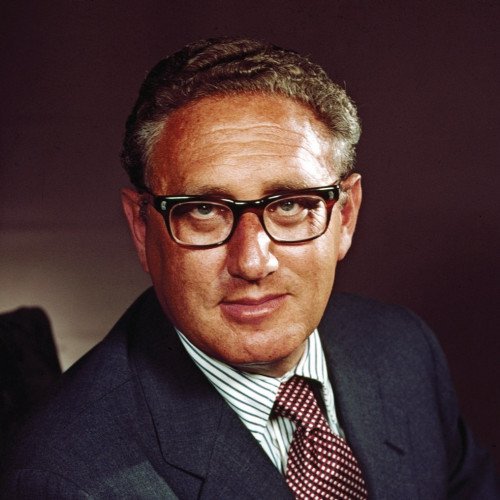
Henry Alfred Kissinger (; German: [ˈkɪsɪŋɐ]; born Heinz Alfred Kissinger; May 27, 1923) is an American politician, diplomat, and geopolitical consult...
Henry Alfred Kissinger (; German: [ˈkɪsɪŋɐ]; born Heinz Alfred Kissinger; May 27, 1923) is an American politician, diplomat, and geopolitical consultant who served as United States Secretary of State and National Security Advisor under the presidential administrations of Richard Nixon and Gerald Ford. A Jewish refugee who fled Nazi Germany with his family in 1938, he became National Security Advisor in 1969 and U.S. Secretary of State in 1973. For his actions negotiating a ceasefire in Vietnam, Kissinger received the 1973 Nobel Peace Prize under controversial circumstances, with two members of the committee resigning in protest.A practitioner of Realpolitik, Kissinger played a prominent role in United States foreign policy between 1969 and 1977. During this period, he pioneered the policy of détente with the Soviet Union, orchestrated the opening of relations with China, engaged in what became known as shuttle diplomacy in the Middle East to end the Yom Kippur War, and negotiated the Paris Peace Accords, ending American involvement in the Vietnam War. Kissinger has also been associated with such controversial policies as U.S. involvement in the 1973 Chilean military coup, a "green light" to Argentina's military junta for their Dirty War, and U.S. support for Pakistan during the Bangladesh War despite the genocide being perpetrated by his allies. After leaving government, he formed Kissinger Associates, an international geopolitical consulting firm. Kissinger has written over a dozen books on diplomatic history and international relations.
Kissinger remains a controversial and polarizing figure in U.S. politics, both condemned as an alleged war criminal by many journalists, political activists, and human rights lawyers, and venerated as a highly effective U.S. Secretary of State by many prominent international relations scholars.
VS
Newt Gingrich
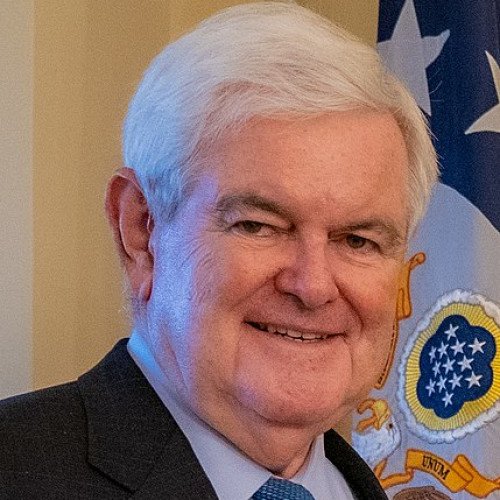
Newton Leroy "Newt" Gingrich (; né McPherson; born June 17, 1943) is an American politician and author who served as the 50th Speaker of the United St...
Newton Leroy "Newt" Gingrich (; né McPherson; born June 17, 1943) is an American politician and author who served as the 50th Speaker of the United States House of Representatives from 1995 to 1999. A member of the Republican Party, he was the U.S. Representative for Georgia's 6th congressional district serving north Atlanta and nearby areas from 1979 until his resignation in 1999. In 2012, Gingrich unsuccessfully ran for the Republican nomination for President of the United States.
A professor of history and geography at the University of West Georgia in the 1970s, Gingrich won election to the U.S. House of Representatives in November 1978, the first Republican in the history of Georgia's 6th congressional district to do so. He served as House Minority Whip from 1989 to 1995. A co-author and architect of the "Contract with America", Gingrich was a major leader in the Republican victory in the 1994 congressional election. In 1995, Time named him "Man of the Year" for "his role in ending the four-decades-long Democratic majority in the House".As House Speaker, Gingrich oversaw passage by the House of welfare reform and a capital gains tax cut in 1997. Gingrich played a key role in several government shutdowns, and impeached President Clinton on a party-line vote in the House. The poor showing by Republicans in the 1998 Congressional elections, a reprimand from the House for Gingrich's ethics violation, pressure from Republican colleagues, and revelations of an extramarital affair with a congressional employee 23 years his junior resulted in Gingrich's resignation from the speakership on November 6, 1998. He resigned altogether from the House on January 3, 1999. Political scientists have credited Gingrich with playing a key role in undermining democratic norms in the United States and hastening political polarization and partisanship.Since leaving the House, Gingrich has remained active in public policy debates and worked as a political consultant. He founded and chaired several policy think tanks, including American Solutions for Winning the Future and the Center for Health Transformation. Gingrich ran for the Republican nomination for President in the 2012 presidential election, and was considered a potential frontrunner at several points in the race. Despite an impressive late victory in the South Carolina primary, Gingrich was ultimately unable to win enough primaries to sustain a viable candidacy, he withdrew from the race in May 2012 and endorsed eventual nominee Mitt Romney. Gingrich later emerged as a key ally of Donald Trump, and was reportedly among the finalists on Trump's short list for running mate in the 2016 election.



Comments (0)
No comments yet. Be the first to share your thoughts!