Robert Joseph Dole (born July 22, 1923) is an American retired politician, statesman, and attorney who represented Kansas in the U.S. Senate from 1969...
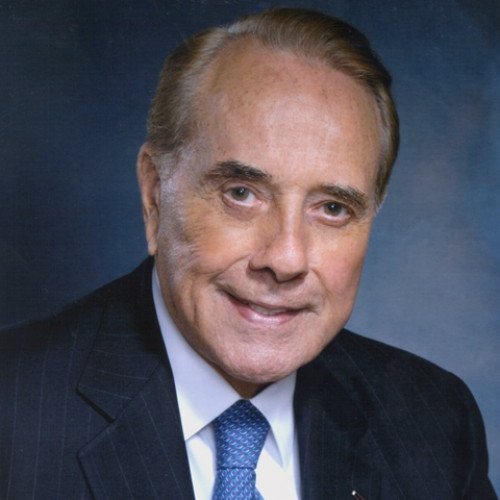
Robert Joseph Dole (born July 22, 1923) is an American retired politician, statesman, and attorney who represented Kansas in the U.S. Senate from 1969 to 1996. He was the Republican Leader of the United States Senate during the final 11 years of his tenure, including three nonconsecutive years as Senate Majority Leader. Prior to his 27 years in the Senate, he served in the U.S House of Representatives from 1961 to 1969. Dole was also the Republican presidential nominee in the 1996 election and the vice presidential nominee in the 1976 election.
Born in Russell, Kansas, Dole established a legal career in Russell after serving with distinction in the United States Army during World War II. After a stint as Russell County Attorney, he won election to the House of Representatives in 1960. In 1968, Dole was elected to the Senate, where he served as chairman of the Republican National Committee from 1971 to 1973 and chairman of the Senate Finance Committee from 1981 to 1985. He led the Senate Republicans from 1985 to his resignation in 1996, and served as Senate Majority Leader from 1985 to 1987 and from 1995 to 1996. In his role as Republican leader, he helped defeat President Bill Clinton's health care plan.
President Gerald Ford chose Dole as his running mate in the 1976 election after Vice President Nelson Rockefeller withdrew from seeking a full term. Ford was defeated by Democrat Jimmy Carter in the general election. Dole sought the Republican presidential nomination in 1980 but quickly dropped out of the race. He experienced more success in the 1988 Republican primaries but was defeated by Vice President George H. W. Bush. Dole won the Republican nomination in 1996 and selected Jack Kemp as his running mate. The Republican ticket lost in the general election to Bill Clinton, making Dole the first unsuccessful major party nominee for both president and vice president. He resigned from the Senate during the 1996 campaign and did not seek public office again after the election.
Though he retired from public office, Dole has remained active in public life since 1996. He appeared in numerous commercials and television programs and served on various councils. In 2012, Dole unsuccessfully advocated Senate ratification of the Convention on the Rights of Persons with Disabilities. He initially supported Jeb Bush in the 2016 Republican primaries, but later became the only former Republican presidential nominee to endorse Donald Trump, after Trump clinched the Republican nomination. Dole is currently a member of the advisory council of the Victims of Communism Memorial Foundation and special counsel at the Washington, D.C., office of law firm Alston & Bird. On January 17, 2018, Dole was awarded the Congressional Gold Medal. He is married to former U.S. Senator Elizabeth Dole of North Carolina.
VS
Donald Rumsfeld
Donald Henry Rumsfeld (born July 9, 1932) is a retired American politician. Rumsfeld served as Secretary of Defense from 1975 to 1977 under Gerald For...
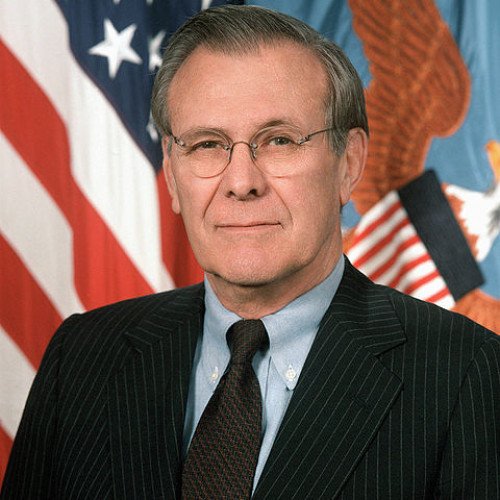
Donald Henry Rumsfeld (born July 9, 1932) is a retired American politician. Rumsfeld served as Secretary of Defense from 1975 to 1977 under Gerald Ford, and again from January 2001 to December 2006 under George W. Bush. He is both the youngest and the second-oldest person to have served as Secretary of Defense. Additionally, Rumsfeld was a three-term U.S. Congressman from Illinois (1963–69), director of the Office of Economic Opportunity (1969–70), counsellor to the president (1969–73), the United States Permanent Representative to NATO (1973–74), and White House Chief of Staff (1974–75). Between his terms as Secretary of Defense, he served as the CEO and chairman of several companies.
Born in Illinois, Rumsfeld attended Princeton University, graduating in 1954 with a degree in political science. After serving in the Navy for three years, he mounted a campaign for Congress in Illinois's 13th Congressional District, winning in 1962 at the age of 30. While in Congress, he was a leading co-sponsor of the Freedom of Information Act. Rumsfeld reluctantly accepted an appointment by President Richard Nixon to head the Office of Economic Opportunity in 1969; appointed counsellor by Nixon and entitled to Cabinet-level status, he would also head up the Economic Stabilization Program before being appointed ambassador to NATO. Called back to Washington in August 1974, Rumsfeld was appointed chief of staff by President Ford. Rumsfeld recruited a young one-time staffer of his, Dick Cheney, to succeed him when Ford nominated him to be Secretary of Defense in 1975. When Ford lost the 1976 election, Rumsfeld returned to private business and financial life, and was named president and CEO of the pharmaceutical corporation G. D. Searle & Company. He was later named CEO of General Instrument from 1990 to 1993 and chairman of Gilead Sciences from 1997 to 2001.
Rumsfeld was appointed Secretary of Defense for a second time in January 2001 by President George W. Bush. As Secretary of Defense, Rumsfeld played a central role in the invasion of Afghanistan and invasion of Iraq. Before and during the Iraq War, he claimed that Iraq had an active weapons of mass destruction program; yet no stockpiles were ever found. A Pentagon Inspector General report found that Rumsfeld's top policy aide "developed, produced, and then disseminated alternative intelligence assessments on the Iraq and al Qaida relationship, which included some conclusions that were inconsistent with the consensus of the Intelligence Community, to senior decision-makers". Rumsfeld's tenure was controversial for its use of torture and the Abu Ghraib torture and prisoner abuse scandal. Rumsfeld gradually lost political support and he resigned in late 2006. In his retirement years, he published an autobiography Known and Unknown: A Memoir as well as Rumsfeld's Rules: Leadership Lessons in Business, Politics, War, and Life.



Comments (0)
No comments yet. Be the first to share your thoughts!