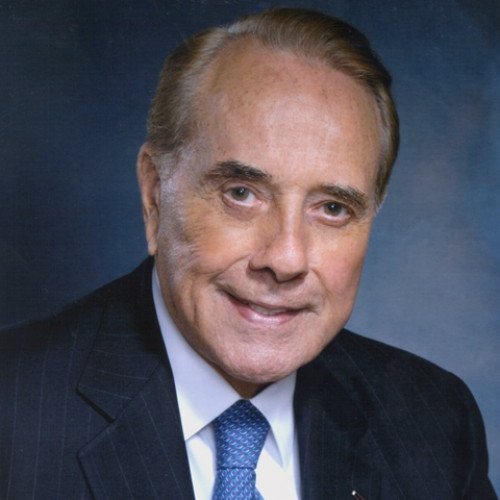
Robert Joseph Dole (born July 22, 1923) is an American retired politician, statesman, and attorney who represented Kansas in the U.S. Senate from 1969...
Robert Joseph Dole (born July 22, 1923) is an American retired politician, statesman, and attorney who represented Kansas in the U.S. Senate from 1969 to 1996. He was the Republican Leader of the United States Senate during the final 11 years of his tenure, including three nonconsecutive years as Senate Majority Leader. Prior to his 27 years in the Senate, he served in the U.S House of Representatives from 1961 to 1969. Dole was also the Republican presidential nominee in the 1996 election and the vice presidential nominee in the 1976 election.
Born in Russell, Kansas, Dole established a legal career in Russell after serving with distinction in the United States Army during World War II. After a stint as Russell County Attorney, he won election to the House of Representatives in 1960. In 1968, Dole was elected to the Senate, where he served as chairman of the Republican National Committee from 1971 to 1973 and chairman of the Senate Finance Committee from 1981 to 1985. He led the Senate Republicans from 1985 to his resignation in 1996, and served as Senate Majority Leader from 1985 to 1987 and from 1995 to 1996. In his role as Republican leader, he helped defeat President Bill Clinton's health care plan.
President Gerald Ford chose Dole as his running mate in the 1976 election after Vice President Nelson Rockefeller withdrew from seeking a full term. Ford was defeated by Democrat Jimmy Carter in the general election. Dole sought the Republican presidential nomination in 1980 but quickly dropped out of the race. He experienced more success in the 1988 Republican primaries but was defeated by Vice President George H. W. Bush. Dole won the Republican nomination in 1996 and selected Jack Kemp as his running mate. The Republican ticket lost in the general election to Bill Clinton, making Dole the first unsuccessful major party nominee for both president and vice president. He resigned from the Senate during the 1996 campaign and did not seek public office again after the election.
Though he retired from public office, Dole has remained active in public life since 1996. He appeared in numerous commercials and television programs and served on various councils. In 2012, Dole unsuccessfully advocated Senate ratification of the Convention on the Rights of Persons with Disabilities. He initially supported Jeb Bush in the 2016 Republican primaries, but later became the only former Republican presidential nominee to endorse Donald Trump, after Trump clinched the Republican nomination. Dole is currently a member of the advisory council of the Victims of Communism Memorial Foundation and special counsel at the Washington, D.C., office of law firm Alston & Bird. On January 17, 2018, Dole was awarded the Congressional Gold Medal. He is married to former U.S. Senator Elizabeth Dole of North Carolina.
VS
Jerry Brown
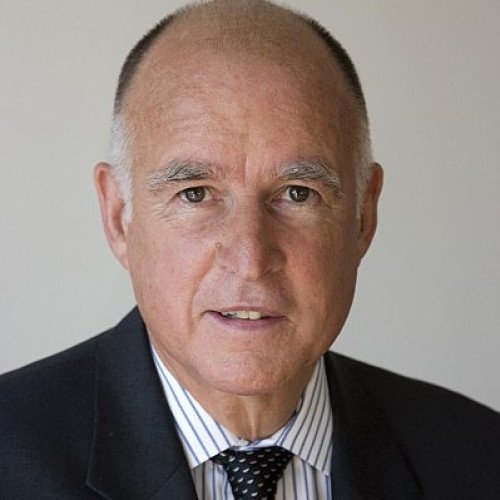
Edmund Gerald Brown Jr. (born April 7, 1938) is an American politician who served as the 34th and 39th governor of California from 1975 to 1983 and 20...
Edmund Gerald Brown Jr. (born April 7, 1938) is an American politician who served as the 34th and 39th governor of California from 1975 to 1983 and 2011 to 2019. A member of the Democratic Party, he was elected Secretary of State of California in the early 1970s; Brown later served as Mayor of Oakland from 1999 to 2007 and Attorney General of California from 2007 to 2011. He was both the oldest and sixth-youngest governor of California due to the 28-year gap between his second and third terms. Upon completing his fourth term in office, Brown became the third longest-serving governor in U.S. history, serving 16 years and 5 days in office.Born in San Francisco, he was the son of Bernice Layne Brown and Pat Brown, who was the 32nd Governor of California (1959–1967). After graduating from the University of California, Berkeley and Yale University, he practiced law and began his political career as a member of the Los Angeles Community College District Board of Trustees (1969–1971). He was elected to serve as the 23rd Secretary of State of California from 1971 to 1975. At 36, Brown was elected to his first term as governor in 1974, making him the youngest California Governor in 111 years. In 1978, he won his second term. During his governorship, Brown ran unsuccessfully as a candidate for the Democratic presidential nomination in 1976 and 1980. He declined to pursue a third term as governor in 1982, instead making an unsuccessful run for the United States Senate that same year.
After traveling abroad, he returned to California and served as the sixth Chairman of the California Democratic Party (1989–1991), attempting to run for U.S. President once more in 1992. He then moved to Oakland, where he hosted a talk radio show; Brown soon returned to public life, serving as Mayor of Oakland (1999–2007) and Attorney General of California (2007–2011). He ran for his third and fourth terms as governor in 2010 and 2014, his eligibility to do so having stemmed from California's constitutional grandfather clause. On October 7, 2013, he became the longest-serving governor in the history of California, surpassing Earl Warren.



Comments (0)
No comments yet. Be the first to share your thoughts!