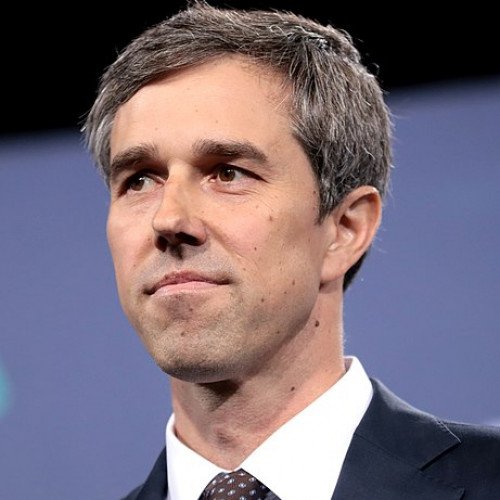
Robert Francis "Beto" O'Rourke (; born September 26, 1972) is an American politician who represented Texas's 16th congressional district in the United...
Robert Francis "Beto" O'Rourke (; born September 26, 1972) is an American politician who represented Texas's 16th congressional district in the United States House of Representatives from 2013 to 2019. O'Rourke is most notable for his 2018 campaign for United States Senate, in which he lost to Republican incumbent Ted Cruz. He sought the 2020 Democratic nomination for President of the United States.
O'Rourke was born into a local political family in El Paso, Texas, and is a graduate of Woodberry Forest School and Columbia University. While studying at Columbia, O'Rourke began a brief music career as bass guitarist in the post-hardcore band Foss. After his college graduation, he returned to El Paso and began a business career. In 2005, he was elected to the El Paso City Council, serving until 2011. O'Rourke was elected to the U.S. House of Representatives in 2012 after defeating eight-term incumbent Democrat Silvestre Reyes in the primary.
After being re-elected to the House in 2014 and 2016, O'Rourke declined to seek re-election in 2018. Instead, he sought the U.S. Senate seat held by Cruz, running a competitive campaign that drew national attention. O'Rourke set a record for most votes ever cast for a Democrat in Texas history. On March 14, 2019, O'Rourke announced his campaign for President of the United States in the 2020 United States presidential election. He suspended his campaign on November 1, 2019, before the primaries began.
VS
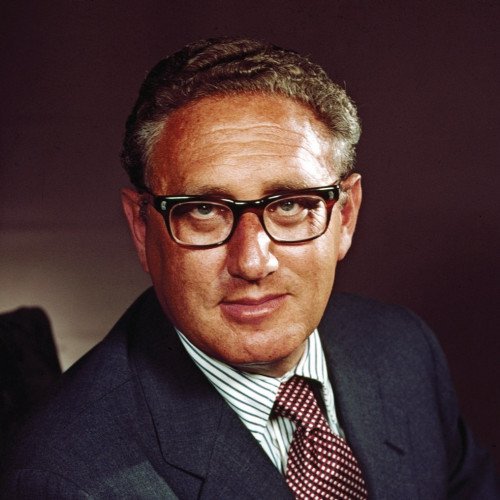
Henry Kissinger
Henry Alfred Kissinger (; German: [ˈkɪsɪŋɐ]; born Heinz Alfred Kissinger; May 27, 1923) is an American politician, diplomat, and geopolitical consult...
Henry Alfred Kissinger (; German: [ˈkɪsɪŋɐ]; born Heinz Alfred Kissinger; May 27, 1923) is an American politician, diplomat, and geopolitical consultant who served as United States Secretary of State and National Security Advisor under the presidential administrations of Richard Nixon and Gerald Ford. A Jewish refugee who fled Nazi Germany with his family in 1938, he became National Security Advisor in 1969 and U.S. Secretary of State in 1973. For his actions negotiating a ceasefire in Vietnam, Kissinger received the 1973 Nobel Peace Prize under controversial circumstances, with two members of the committee resigning in protest.A practitioner of Realpolitik, Kissinger played a prominent role in United States foreign policy between 1969 and 1977. During this period, he pioneered the policy of détente with the Soviet Union, orchestrated the opening of relations with China, engaged in what became known as shuttle diplomacy in the Middle East to end the Yom Kippur War, and negotiated the Paris Peace Accords, ending American involvement in the Vietnam War. Kissinger has also been associated with such controversial policies as U.S. involvement in the 1973 Chilean military coup, a "green light" to Argentina's military junta for their Dirty War, and U.S. support for Pakistan during the Bangladesh War despite the genocide being perpetrated by his allies. After leaving government, he formed Kissinger Associates, an international geopolitical consulting firm. Kissinger has written over a dozen books on diplomatic history and international relations.
Kissinger remains a controversial and polarizing figure in U.S. politics, both condemned as an alleged war criminal by many journalists, political activists, and human rights lawyers, and venerated as a highly effective U.S. Secretary of State by many prominent international relations scholars.



Comments (0)
No comments yet. Be the first to share your thoughts!