Charles Ellis Schumer (; born November 23, 1950) is an American politician serving as the Senate Majority Leader since January 20, 2021. A member of t...
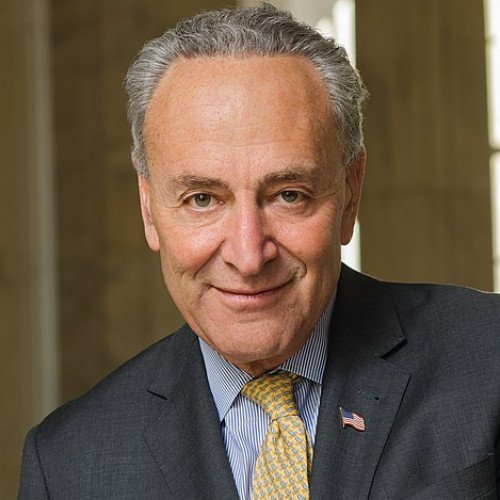
Charles Ellis Schumer (; born November 23, 1950) is an American politician serving as the Senate Majority Leader since January 20, 2021. A member of the Democratic Party, Schumer is the senior United States senator from New York, a seat to which he was first elected in 1998. He is the current dean of New York's congressional delegation.
A native of Brooklyn and a graduate of Harvard College and Harvard Law School, Schumer was a three-term member of the New York State Assembly from 1975 to 1980. Schumer served in the United States House of Representatives from 1981 to 1999, first representing New York's 16th congressional district before being redistricted to the 10th congressional district in 1983 and 9th congressional district ten years later. In 1998, Schumer was elected as a U.S. Senator after defeating three-term Republican incumbent Al D'Amato. He was subsequently reelected in 2004 with 71 percent of the vote, in 2010 with 66 percent of the vote, and in 2016 with 70 percent of the vote.
Schumer was chairman of the Democratic Senatorial Campaign Committee from 2005 to 2009, during which time he oversaw 14 Democratic gains in the Senate in the 2006 and 2008 elections. He was the third-ranking Democrat in the Senate, behind Senate Minority Leader Harry Reid and Minority Whip Dick Durbin. He served as Vice Chairman of the Democratic Caucus in the Senate from 2007 to 2017 and was chairman of the Senate Democratic Policy Committee from 2011 to 2017. Schumer won his fourth term in the Senate in 2016 and was then unanimously elected Democratic leader to succeed Harry Reid, who was retiring. In January 2021, Schumer became Senate Majority Leader, and the first Jewish leader of either chamber of Congress.
VS
Howard Dean
Howard Brush Dean III (born November 17, 1948) is an American physician, author, and retired politician who served as Governor of Vermont from 1991 to...
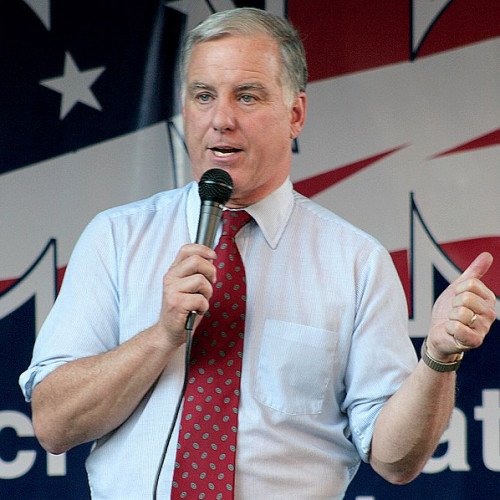
Howard Brush Dean III (born November 17, 1948) is an American physician, author, and retired politician who served as Governor of Vermont from 1991 to 2003 and Chair of the Democratic National Committee (DNC) from 2005 to 2009. Dean was a candidate for the Democratic nomination in the 2004 presidential election. His implementation of the fifty-state strategy as head of the DNC is credited with the Democratic victories in the 2006 and 2008 elections. Afterward, he became a political commentator and consultant to McKenna Long & Aldridge, a law and lobbying firm.
Before entering politics, Dean earned his medical degree from the Albert Einstein College of Medicine in 1978. Dean served as a member of the Vermont House of Representatives from 1983 to 1986 and as Lieutenant Governor of Vermont from 1987 to 1991. Both were part-time positions that enabled him to continue practicing medicine. In 1991, Dean became governor of Vermont when Richard A. Snelling died in office. Dean was subsequently elected to five two-year terms, serving from 1991 to 2003, making him the second longest-serving governor in Vermont history, after Thomas Chittenden (1778–1789 and 1790–1797). Dean served as chairman of the National Governors Association from 1994 to 1995; during his term, Vermont paid off much of its public debt and had a balanced budget 11 times, lowering income taxes twice. Dean also oversaw the expansion of the "Dr. Dynasaur" program, which ensures universal health care for children and pregnant women in the state. He is a noted staunch supporter of universal health care.Dean denounced the 2003 invasion of Iraq and called on Democrats to oppose the Bush administration. In the 2004 election, Dean was the top fundraiser and front runner, prior to the Iowa caucus, for the Democratic Party presidential nomination. Although he lost the nomination to Senator John Kerry of Massachusetts, Dean pioneered Internet-based fundraising and grassroots organizing, which is centered on mass appeal to small donors which is more cost efficient than the more expensive contacting of fewer potential larger donors, and promotes active participatory democracy among the general public. In 2004, Dean founded Democracy for America, a progressive political action committee. He was later elected chairman of the Democratic National Committee in February 2005. As chairman of the party, Dean created and employed the 50 State Strategy that attempted to make Democrats competitive in normally conservative states often dismissed in the past as "solid red". The success of the strategy became apparent after the 2006 midterm elections, where Democrats took back the House and picked up seats in the Senate from normally Republican states such as Missouri and Montana. In the 2008 presidential election, Barack Obama used the 50 state strategy as the backbone of his candidacy.
Dean was named chairman emeritus of the DNC upon his retirement. Since retiring from the DNC chairman position, Dean has held neither elected office nor an official position in the Democratic Party and, as of 2015, was working for global law firm Dentons as part of the firm's public policy and regulation practice. In 2013, Dean expressed interest in running for the presidency in 2016, but instead supported former Secretary of State Hillary Clinton's run for president. Dean endorsed Clinton over her competitor Senator Bernie Sanders in spite of the fact that Sanders represented the state of Vermont, where Dean had been governor.



Comments (0)
No comments yet. Be the first to share your thoughts!