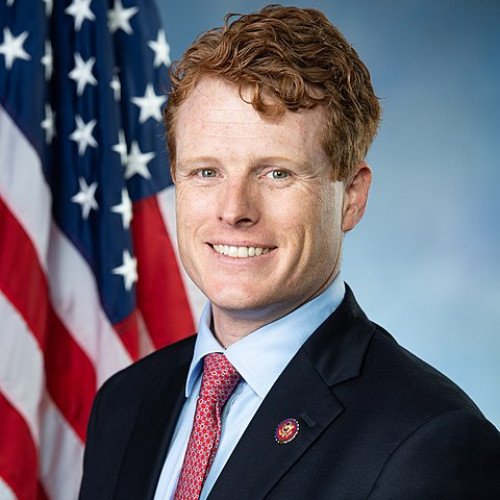
Joseph Patrick Kennedy III (born October 4, 1980) is an American lawyer and politician who served as the U.S. Representative for Massachusetts's 4th c...
Joseph Patrick Kennedy III (born October 4, 1980) is an American lawyer and politician who served as the U.S. Representative for Massachusetts's 4th congressional district from 2013 to 2021. A member of the Democratic Party, he represented a district that extends from Boston's western suburbs to the state's South Coast. He worked as an assistant district attorney in the Cape and Islands and Middlesex County, Massachusetts, offices before his election to Congress.
A member of the Kennedy family, he is a son of U.S. Representative Joseph P. Kennedy II, a grandson of U.S. Senator and U.S. Attorney General Robert F. Kennedy, a grandnephew of U.S. President John F. Kennedy and U.S. Senator Ted Kennedy, and a great-grandson of U.S. Ambassador to the United Kingdom Joseph P. Kennedy Sr.
Born in Boston, Kennedy was raised in the area with his twin brother, Matthew Rauch Kennedy. After graduating from Stanford University with a bachelor's degree, he spent two years in the Dominican Republic as a member of the Peace Corps before earning a Juris Doctor at Harvard Law School in 2009. He resigned from his role as assistant district attorney in early 2012 to run for the U.S. House of Representatives seat held by the retiring Barney Frank. Kennedy was sworn into office in January 2013 and sat on the House Committee on Energy and Commerce.
In 2020, rather than run for reelection to his House seat, Kennedy unsuccessfully challenged Senator Ed Markey for the Democratic nomination in the Massachusetts U.S. Senate election. Upon the conclusion of his term on January 3, 2021, he left Congress.
VS
Newt Gingrich
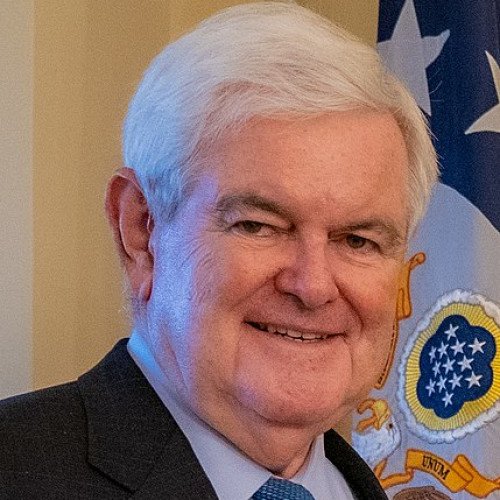
Newton Leroy "Newt" Gingrich (; né McPherson; born June 17, 1943) is an American politician and author who served as the 50th Speaker of the United St...
Newton Leroy "Newt" Gingrich (; né McPherson; born June 17, 1943) is an American politician and author who served as the 50th Speaker of the United States House of Representatives from 1995 to 1999. A member of the Republican Party, he was the U.S. Representative for Georgia's 6th congressional district serving north Atlanta and nearby areas from 1979 until his resignation in 1999. In 2012, Gingrich unsuccessfully ran for the Republican nomination for President of the United States.
A professor of history and geography at the University of West Georgia in the 1970s, Gingrich won election to the U.S. House of Representatives in November 1978, the first Republican in the history of Georgia's 6th congressional district to do so. He served as House Minority Whip from 1989 to 1995. A co-author and architect of the "Contract with America", Gingrich was a major leader in the Republican victory in the 1994 congressional election. In 1995, Time named him "Man of the Year" for "his role in ending the four-decades-long Democratic majority in the House".As House Speaker, Gingrich oversaw passage by the House of welfare reform and a capital gains tax cut in 1997. Gingrich played a key role in several government shutdowns, and impeached President Clinton on a party-line vote in the House. The poor showing by Republicans in the 1998 Congressional elections, a reprimand from the House for Gingrich's ethics violation, pressure from Republican colleagues, and revelations of an extramarital affair with a congressional employee 23 years his junior resulted in Gingrich's resignation from the speakership on November 6, 1998. He resigned altogether from the House on January 3, 1999. Political scientists have credited Gingrich with playing a key role in undermining democratic norms in the United States and hastening political polarization and partisanship.Since leaving the House, Gingrich has remained active in public policy debates and worked as a political consultant. He founded and chaired several policy think tanks, including American Solutions for Winning the Future and the Center for Health Transformation. Gingrich ran for the Republican nomination for President in the 2012 presidential election, and was considered a potential frontrunner at several points in the race. Despite an impressive late victory in the South Carolina primary, Gingrich was ultimately unable to win enough primaries to sustain a viable candidacy, he withdrew from the race in May 2012 and endorsed eventual nominee Mitt Romney. Gingrich later emerged as a key ally of Donald Trump, and was reportedly among the finalists on Trump's short list for running mate in the 2016 election.



Comments (0)
No comments yet. Be the first to share your thoughts!