Albert Arnold Gore Jr. (born March 31, 1948) is an American politician and environmentalist who served as the 45th vice president of the United States...
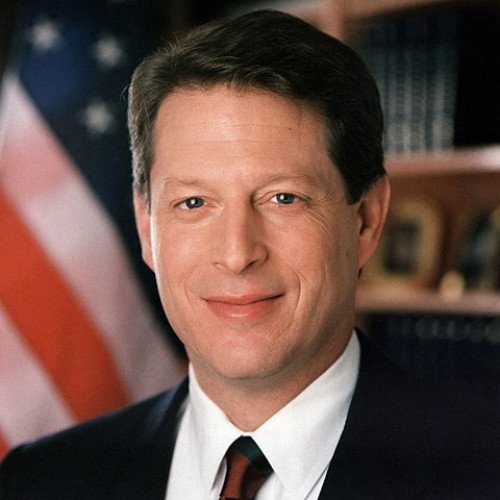
Albert Arnold Gore Jr. (born March 31, 1948) is an American politician and environmentalist who served as the 45th vice president of the United States from 1993 to 2001. Gore was Bill Clinton's running mate in their successful campaign in 1992 and the pair were re-elected in 1996. Near the end of Clinton's second term, Gore was selected as the Democratic nominee for the 2000 presidential election but lost the election in a very close race after a Florida recount. After his term as vice-president ended in 2001, Gore remained prominent as an author and environmental activist, whose work in climate change activism earned him (jointly with the IPCC) the Nobel Peace Prize in 2007. In 2008, Gore won the Dan David Prize for Social Responsibility.Gore was an elected official for 24 years. He was a representative from Tennessee (1977–1985) and from 1985 to 1993 served as a senator from that state. He served as vice president during the Clinton administration from 1993 to 2001. The 2000 presidential election was one of the closest presidential races in history. Gore won the popular vote, but after a controversial election dispute over a Florida recount (settled by the U.S. Supreme Court, which ruled 5–4 in favor of Bush), he lost the election to Republican opponent George W. Bush in the Electoral College.
Gore is the founder and current chair of The Climate Reality Project, the co-founder and chair of Generation Investment Management, the now-defunct Current TV network, a member of the Board of Directors of Apple Inc. and a senior adviser to Google. Gore is also a partner in the venture capital firm Kleiner Perkins, heading its climate change solutions group. He has served as a visiting professor at Middle Tennessee State University, Columbia University Graduate School of Journalism, Fisk University and the University of California, Los Angeles. He served on the Board of Directors of World Resources Institute.Gore has received a number of awards that include the Nobel Peace Prize (joint award with the Intergovernmental Panel on Climate Change, 2007), a Grammy Award for Best Spoken Word Album (2009) for his book An Inconvenient Truth, a Primetime Emmy Award for Current TV (2007), and a Webby Award (2005). Gore was also the subject of the Academy Award winning (2007) documentary An Inconvenient Truth in 2006. In 2007, he was named a runner-up for Time's 2007 Person of the Year.
VS
Barry Goldwater
Barry Morris Goldwater (January 2, 1909 – May 29, 1998) was an American politician, businessman, and author who was a five-term Senator from Arizona (...
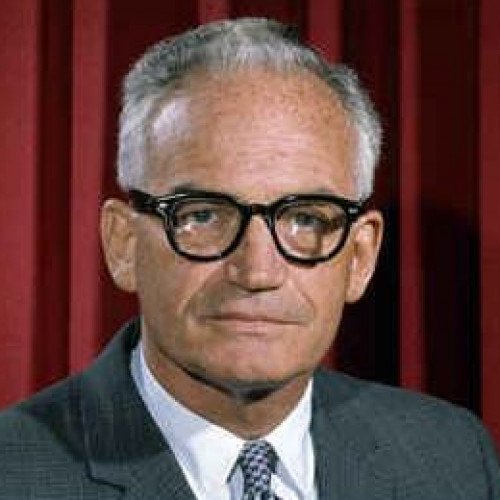
Barry Morris Goldwater (January 2, 1909 – May 29, 1998) was an American politician, businessman, and author who was a five-term Senator from Arizona (1953–1965, 1969–1987) and the Republican Party nominee for president of the United States in 1964. Despite his loss of the 1964 presidential election in a landslide, Goldwater is the politician most often credited with having sparked the resurgence of the American conservative political movement in the 1960s. He also had a substantial impact on the libertarian movement.Goldwater rejected the legacy of the New Deal and, along with the conservative coalition, fought against the New Deal coalition. A member of the NAACP and active supporter of desegregation in Phoenix, Goldwater voted in favor of the Civil Rights Act of 1957 and the 24th Amendment to the U.S. Constitution, but opposed the Civil Rights Act of 1964, believing it to be an overreach by the federal government—a decision that considerably anguished him. In 1964, Goldwater mobilized a large conservative constituency to win the hard-fought Republican presidential primaries. Although raised as an Episcopalian, Goldwater was the first candidate of ethnically Jewish heritage to be nominated for President by a major American party (his father was Jewish). Goldwater's platform ultimately failed to gain the support of the electorate and he lost the 1964 presidential election to incumbent Democrat Lyndon B. Johnson by one of the largest margins in history. Goldwater returned to the Senate in 1969 and specialized in defense and foreign policy. As an elder statesman of the party, Goldwater successfully urged President Richard Nixon to resign in 1974 when evidence of a cover-up in the Watergate scandal became overwhelming and impeachment was imminent.
Goldwater narrowly won re-election in 1980 for what would be his final and most influential term in the senate. In 1986, Goldwater oversaw passage of the Goldwater–Nichols Act, arguably his most significant legislative achievement, which strengthened civilian authority in the Department of Defense. The following year, he retired from the Senate and was succeeded by John McCain, who praised his predecessor as the man who "transformed the Republican Party from an Eastern elitist organization to the breeding ground for the election of Ronald Reagan". Goldwater strongly supported the 1980 presidential campaign of Reagan, who had become the standard-bearer of the conservative movement after his "A Time for Choosing" speech. Reagan reflected many of the principles of Goldwater's earlier run in his campaign. The Washington Post columnist George Will took note of this, writing: "We [...] who voted for him in 1964 believe he won, it just took 16 years to count the votes".
Goldwater's views grew increasingly libertarian as he neared the end of his career. After leaving the Senate, Goldwater's views cemented as libertarian. He criticized the "moneymaking ventures by fellows like Pat Robertson and others [in the Republican Party] who are trying to... make a religious organization out of it." He lobbied for homosexuals to be able to serve openly in the military, opposed the Clinton administration's plan for health care reform, supported abortion rights, and the legalization of medicinal marijuana.



Comments (0)
No comments yet. Be the first to share your thoughts!