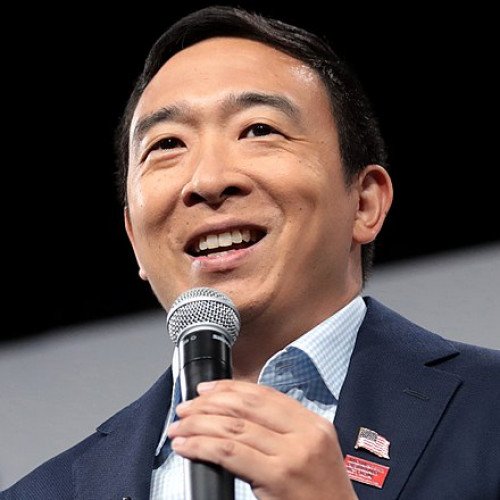
Andrew M. Yang (born January 13, 1975) is an American entrepreneur, politician, philanthropist and Democratic candidate for New York City mayor. Orig...
Andrew M. Yang (born January 13, 1975) is an American entrepreneur, politician, philanthropist and Democratic candidate for New York City mayor. Originally a lawyer, Yang began working in startups and early stage growth companies as a founder or executive from 2000 to 2009. In 2011, he founded Venture for America (VFA), a nonprofit organization focused on creating jobs in cities struggling to recover from the Great Recession. He ran in the 2020 Democratic presidential primaries, and is running in the 2021 New York City mayoral election.
The son of immigrants from Taiwan, Yang was born and raised in New York. He attended Brown University and then Columbia Law School. Dissatisfied with his work as an attorney, Yang began working for startups during the dot-com bubble before spending a decade as an executive at test preparation company Manhattan Prep. In 2011, Yang founded VFA, which recruits top college graduates into a two-year fellowship program at startups in developing cities across the United States. The Obama administration selected him in 2011 as a "Champion of Change" and in 2015 as a "Presidential Ambassador for Global Entrepreneurship." Yang left VFA in 2017 to focus on his presidential campaign. In 2018, he authored The War on Normal People, which outlines several of his campaign's central ideas.
On November 6, 2017, Yang filed with the Federal Election Commission (FEC) to run for President of the United States in the 2020 election. Yang's campaign largely focused on responding to the rapid development of automation, which is increasingly leading to workforce challenges and economic instability in the United States. His signature policy was the "Freedom Dividend," a universal basic income (UBI) of $1,000 a month to every American adult as a response to job displacement by automation, one of the primary factors that he claims led to Donald Trump's election in 2016. Considered a dark horse candidate throughout much of the primary, Yang received significant popularity online, with The New York Times calling him "The Internet's Favorite Candidate". News outlets described Yang as the most surprising candidate of the 2020 election cycle, going from a relative unknown to a major competitor in the race. Yang qualified for and participated in seven of the first eight Democratic debates, and has been credited with elevating discussions on UBI, automation, and autism to the national level, as well as for engaging Asian Americans in presidential politics.Yang's campaign was noted for its happy-go-lucky and "tech-friendly" nature. His supporters, informally known as the "Yang Gang", included several high-profile celebrity endorsements and were noted for their ideological and political diversity. Yang suspended his campaign on February 11, 2020, shortly after the New Hampshire primary, pledging that he and his movement are "just getting started." Following his campaign's end, Yang joined CNN as a political commentator, announced the creation of the political nonprofit organization Humanity Forward, and is running for the Democratic nomination in the 2021 New York City mayoral election.
VS
Joe Arpaio
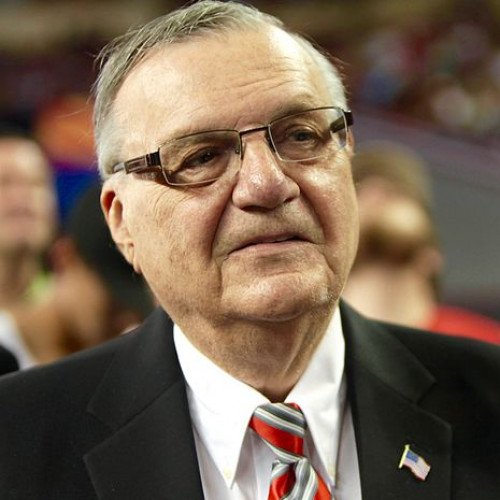
Joseph Michael Arpaio (; born June 14, 1932) is an American former law enforcement officer and politician. He served as the 36th Sheriff of Maricopa C...
Joseph Michael Arpaio (; born June 14, 1932) is an American former law enforcement officer and politician. He served as the 36th Sheriff of Maricopa County, Arizona for 24 years, from 1993 to 2017, losing reelection to Democrat Paul Penzone in 2016.
Starting in 2005, Arpaio took an outspoken stance against illegal immigration, styling himself as "America's Toughest Sheriff". In 2010, he became a flashpoint for opposition to Arizona's SB1070 anti-illegal immigrant law, which was largely struck down by the Supreme Court of the United States. Arpaio is also known for investigating former U.S. President Barack Obama's birth certificate, and, as of 2018, he continued to claim without evidence that it was forged.Arpaio has been accused of numerous types of police misconduct, including abuse of power, misuse of funds, failure to investigate sex crimes, criminal negligence, abuse of suspects in custody, improper clearance of cases, unlawful enforcement of immigration laws, and election law violations. A Federal court monitor was appointed to oversee his office's operations because of complaints of racial profiling. The U.S. Department of Justice concluded that Arpaio oversaw the worst pattern of racial profiling in U.S. history, and subsequently filed suit against him for unlawful discriminatory police conduct. Arpaio and the MCSO were named as defendants in dozens of civil lawsuits brought by citizens arrested by Arpaio and his deputies alleging wrongful arrest, wrongful death, entrapment and other claims, costing taxpayers in Maricopa County over $140 million in litigation against Arpaio during his tenure as sheriff.Over the course of his career, Arpaio was the subject of several federal civil rights lawsuits. In one case, he was a defendant in a decade-long suit in which a federal court issued an injunction barring him from conducting further "immigration round-ups". A federal court subsequently found that after the order was issued, Arpaio's office continued to detain "persons for further investigation without reasonable suspicion that a crime has been or is being committed." In July 2017, he was convicted of criminal contempt of court, a crime for which he was pardoned by President Donald Trump on August 25, 2017. In a separate racial-profiling case which concluded in 2013, Arpaio and his subordinates were found to have unfairly targeted Hispanics in conducting traffic stops.Although Arpaio sought another term as Maricopa County Sheriff in 2016, the contempt of court conviction eroded much of his remaining political support, and he was defeated in the election by Paul Penzone, a Democrat who reversed many of Arpaio's policies after taking office. Arpaio was an unsuccessful candidate in Arizona's Republican primary election for U.S. Senate in 2018. On August 25, 2019, Arpaio issued a statement saying that he would run for sheriff of Maricopa County in 2020. He lost the August 2020 primary election.



Comments (0)
No comments yet. Be the first to share your thoughts!