Vietnam (also written as Viet Nam, Vietnamese: Việt Nam, [vîət nāːm] (listen)), officially the Socialist Republic of Vietnam (Vietnamese: Cộng hòa Xã...
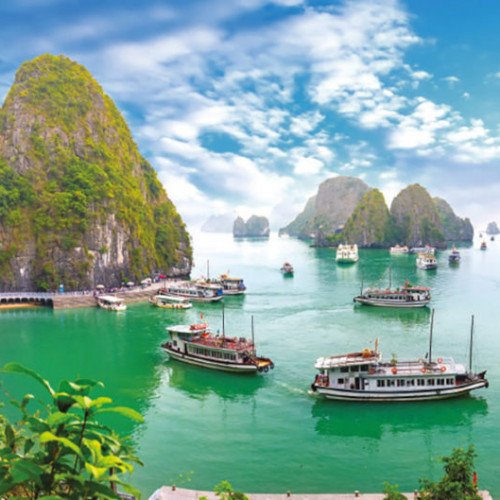
Vietnam (also written as Viet Nam, Vietnamese: Việt Nam, [vîət nāːm] (listen)), officially the Socialist Republic of Vietnam (Vietnamese: Cộng hòa Xã hội chủ nghĩa Việt Nam), is a country in Southeast Asia and the easternmost country on the Indochinese Peninsula. With an estimated 97.8 million inhabitants as of 2020, it is the 16th most populous country in the world. Vietnam shares its land borders with China to the north, and Laos and Cambodia to the west. It shares its maritime borders with Thailand through the Gulf of Thailand, and the Philippines, Indonesia and Malaysia through the South China Sea. Its capital city is Hanoi, and its most populous city is Ho Chi Minh City.
Archaeological excavations indicate that Vietnam was inhabited as early as the Paleolithic age. The ancient Vietnamese nation, which was centered on the Red River valley and nearby coastal areas, was annexed by the Han dynasty in the 2nd century BC, which subsequently made Vietnam a division of Imperial China for over a millennium. The first independent monarchy emerged in the 10th century AD. This paved the way for successive imperial dynasties as the nation expanded southward until the Indochina Peninsula was colonised by the French in the late 19th century. Modern Vietnam was born upon the Proclamation of Independence from France in 1945. Following Vietnamese victory against the French in the First Indochina War, which ended in 1954, the nation was divided into two rival states: communist North and anti-communist South. Conflicts intensified in the Vietnam War, which saw extensive US intervention in support of South Vietnam and Soviet and Chinese support for the North, and ended with North Vietnamese victory in 1975.
After North and South Vietnam were reunified as a communist state under a unitary socialist government in 1976, the country became economically and politically isolated until 1986, when the Communist Party initiated a series of economic and political reforms that facilitated Vietnamese integration into world politics and the global economy. As a result of the successful reforms, Vietnam has enjoyed a high GDP growth rate, consistently ranked among the fastest-growing countries in the world. It nevertheless faces challenges including corruption, pollution, poverty, inadequate social welfare and a poor human rights record, including increasing persecution of religious groups and human rights advocates and intensifying restrictions on civil liberties. By 2010, Vietnam had established diplomatic relations with 178 countries. It is a member of such international organisations as the United Nations (UN), the Association of Southeast Asian Nations (ASEAN), the Asia-Pacific Economic Cooperation (APEC) forum, and the World Trade Organization (WTO).
VS
Taiwan
Taiwan (traditional Chinese: 臺灣/台灣; simplified Chinese: 台湾; pinyin: Táiwān), officially the Republic of China (ROC), is a country in East Asia....
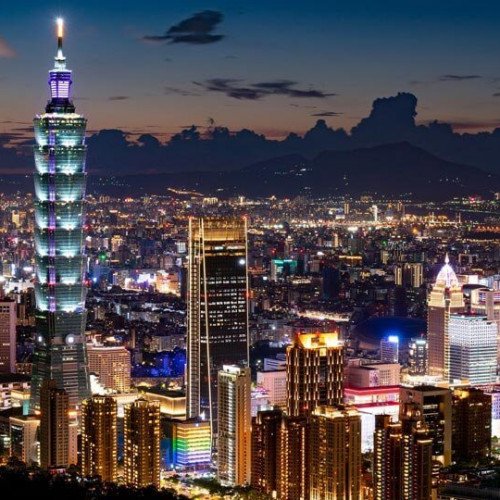
Taiwan (traditional Chinese: 臺灣/台灣; simplified Chinese: 台湾; pinyin: Táiwān), officially the Republic of China (ROC), is a country in East Asia. Neighbouring countries include the People's Republic of China (PRC) to the northwest, Japan to the northeast, and the Philippines to the south. The main island of Taiwan has an area of 35,808 square kilometres (13,826 sq mi), with mountain ranges dominating the eastern two-thirds and plains in the western third, where its highly urbanised population is concentrated. Taipei is the capital as well as the largest metropolitan area of Taiwan. Other major cities include New Taipei, Kaohsiung, Taichung, Tainan and Taoyuan. With 23.57 million inhabitants, Taiwan is among the most densely populated countries.
Austronesian-speaking ancestors of Taiwanese indigenous peoples settled the island around 6,000 years ago. In the 17th century, partial Dutch colonization opened the island to large-scale Han Chinese immigration. After the brief rule of part of western Taiwan by the Kingdom of Tungning, the island was annexed in 1683 by the Qing dynasty of China, and ceded to the Empire of Japan in 1895. The Republic of China, which had overthrown and succeeded the Qing in 1911, took control of Taiwan on behalf of the World War II Allies following the surrender of Japan in 1945. The resumption of the Chinese Civil War resulted in the ROC's loss of mainland China to forces of the Chinese Communist Party and retreat to Taiwan in 1949. Its effective jurisdiction has since been limited to Taiwan and numerous smaller islands.
In the early 1960s, Taiwan entered a period of rapid economic growth and industrialisation called the "Taiwan Miracle". In the late 1980s and early 1990s, the ROC transitioned from a one-party military dictatorship to a multi-party democracy with a semi-presidential system. Taiwan's export-oriented industrial economy is the 21st-largest in the world by nominal GDP, and 20th-largest by PPP measures, with major contributions from steel, machinery, electronics and chemicals manufacturing. Taiwan is a developed country, ranking 15th in GDP per capita. It is ranked highly in terms of political and civil liberties, education, health care and human development.The political status of Taiwan is contentious. The ROC government held China's seat in the UN until it was replaced by the PRC in 1971. It continued to claim to be the legitimate representative of China, though this claim has been downplayed since democratization in the 1990s. Taiwan is claimed by the PRC, which refuses diplomatic relations with countries that recognise the ROC. Taiwan maintains official diplomatic relations with 14 out of 193 UN member states and the Holy See, though many countries maintain unofficial diplomatic ties with Taiwan through representative offices and institutions that function as de facto embassies and consulates. International organisations in which the PRC participates either refuse to grant membership to Taiwan or allow it to participate only on a non-state basis under various names. Domestically, the major political contention is between parties favouring eventual Chinese unification and promoting a Chinese identity contrasted with those aspiring to independence and promoting Taiwanese identity, although both sides have moderated their positions to broaden their appeal.



Comments (0)
No comments yet. Be the first to share your thoughts!